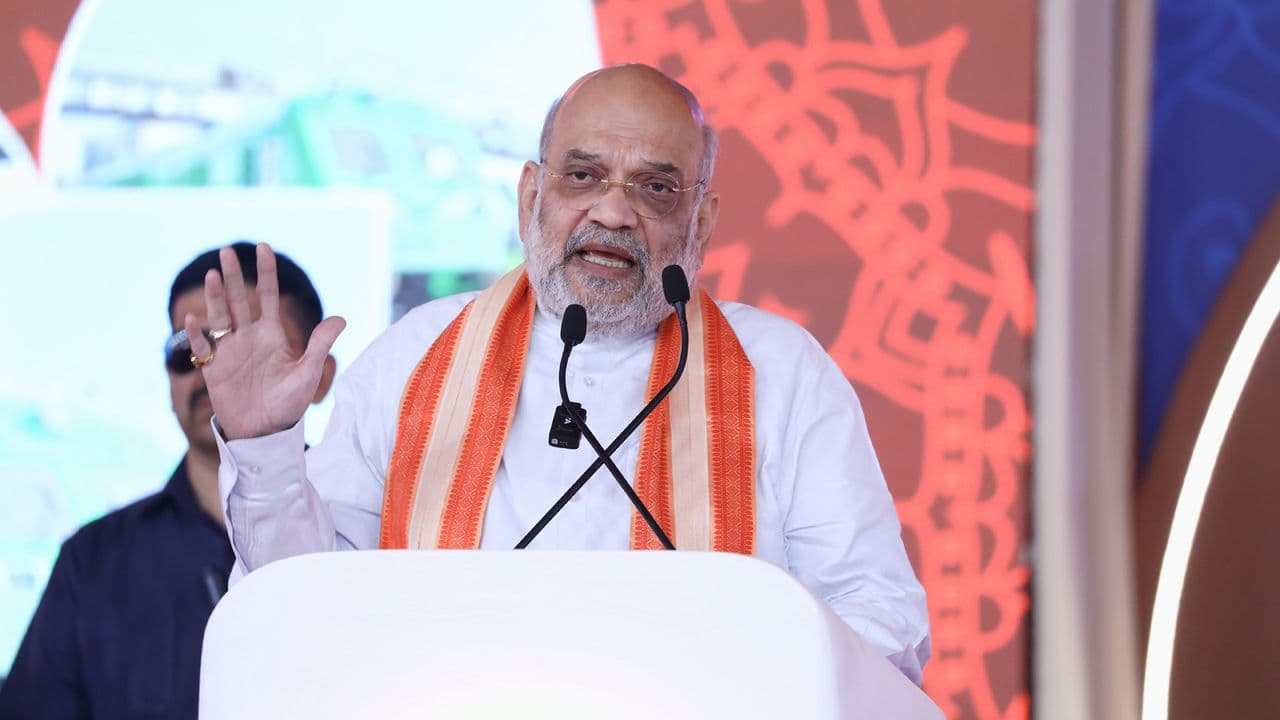
Ahmedabad: Union Home Minister Amit Shah on Sunday flagged off what the government described as India’s first LNG-powered train from Sabarmati Railway Station in Ahmedabad and inaugurated and launched railway development projects worth ₹1,472 crore in Gujarat.
Gujarat Chief Minister Bhupendra Patel and other dignitaries were present at the programme.
The projects cover railway maintenance, train safety, passenger amenities and connectivity, with Shah highlighting the LNG-powered train as part of efforts to reduce dependence on conventional diesel fuel. The event also included the inauguration of a ₹700-crore WAG-12 locomotive maintenance shed. DD India
LNG train flagged off from Sabarmati
Shah said the LNG-powered train would contribute to environmental protection and described the railway initiatives as significant for environmental sustainability, passenger convenience and safety.
He also highlighted the transformation of the Sabarmati railway area, particularly in terms of passenger amenities, safety and connectivity.
Recalling Sabarmati’s historical association with Mahatma Gandhi, Shah said the area was linked to Gandhi’s experiments with Satyagraha, simple living, rural development and khadi. He said the effort to translate these ideals into action had begun from Sabarmati.
₹700 crore WAG-12 maintenance shed
Among the major projects inaugurated was a WAG-12 locomotive maintenance shed, constructed at a cost of ₹700 crore.
Shah highlighted the capabilities of the WAG-12 locomotive, particularly its 12,000-horsepower twin-section configuration, which enables it to haul freight equivalent to the capacity of nearly 600 trucks, according to his remarks.
He said the deployment of high-capacity locomotives would improve the efficiency of freight transportation by allowing a single locomotive to undertake operations that previously required two locomotives.
Kavach safety system and track doubling
The programme also covered the installation of the Kavach automatic train protection system on the Sabarmati-Kalol-Sabarmati section.
The Kavach project on this section has been taken up at a cost of ₹48 crore. Work has also commenced on Kavach-related projects on the Ahmedabad-Palanpur and Ahmedabad-Samakhiali sections.
In addition, work has begun on the doubling of the Sabarmati-Sarkhej railway line, aimed at strengthening rail capacity and connectivity in the region.
Double-stack trains to strengthen freight movement
Shah also referred to the trial of the country's first long-haul double-stack container train from Jawaharlal Nehru Port near Mumbai to Vadodara.
He said greater use of double-stack freight trains could increase the volume of goods transported by rail, particularly given the limited rail network available for freight movement compared with the overall demand.
Shah also spoke about the conversion of an 11,000-km corridor into a four-lane network, which he said would facilitate freight movement towards major routes including Delhi-Howrah and Delhi-Guwahati.
Focus on alternative energy and electrification
The Home Minister highlighted the expansion of railway electrification and the reduction in diesel consumption.
According to figures cited in his address, railway diesel consumption fell from 293 crore litres in 2015-16 to 108 crore litres in 2024-25.
He said railway electrification had increased from around 30 per cent before 2014 to 99.6 per cent, with the remaining portion expected to be completed soon.
Shah also cited an increase in annual railway electrification from 75 km in 2010-11 to 7,188 km in 2023-24.
He referred to the introduction of hydrogen-powered railway technology as another step towards alternative energy. The Ministry of Railways has said India’s first hydrogen-powered train, Namo Green Rail, was inaugurated on July 17, 2026, as a demonstration of hydrogen-powered train technology. Press Information Bureau
Railway safety and domestic manufacturing
Shah said expenditure on railway safety had increased significantly during the period discussed in his address, while locomotive production capacity had also expanded.
He linked the expansion of domestic railway manufacturing to the government's Make in India and Aatmanirbhar Bharat initiatives, saying these programmes had strengthened India's ability to manufacture railway equipment and locomotives domestically.
Gujarat railway allocation rises
Shah also highlighted the increase in railway allocations for Gujarat.
According to figures cited by him, the state's railway allocation during 2009-14 stood at ₹589 crore, compared with ₹17,366 crore for 2026-27.
He said the increase reflected the pace of railway development in Gujarat and called for development-related debates to be based on facts and figures.
Shah also criticised opposition parties over their record in government and made allegations relating to corruption during previous administrations. These remarks were part of his political criticism at the event.
The railway projects launched at Sabarmati come as Gujarat continues to see major investments in railway infrastructure, including the Mumbai-Ahmedabad High Speed Rail project, whose Sabarmati station is being developed as a multimodal transport hub connecting high-speed rail with conventional rail, metro and BRTS services.