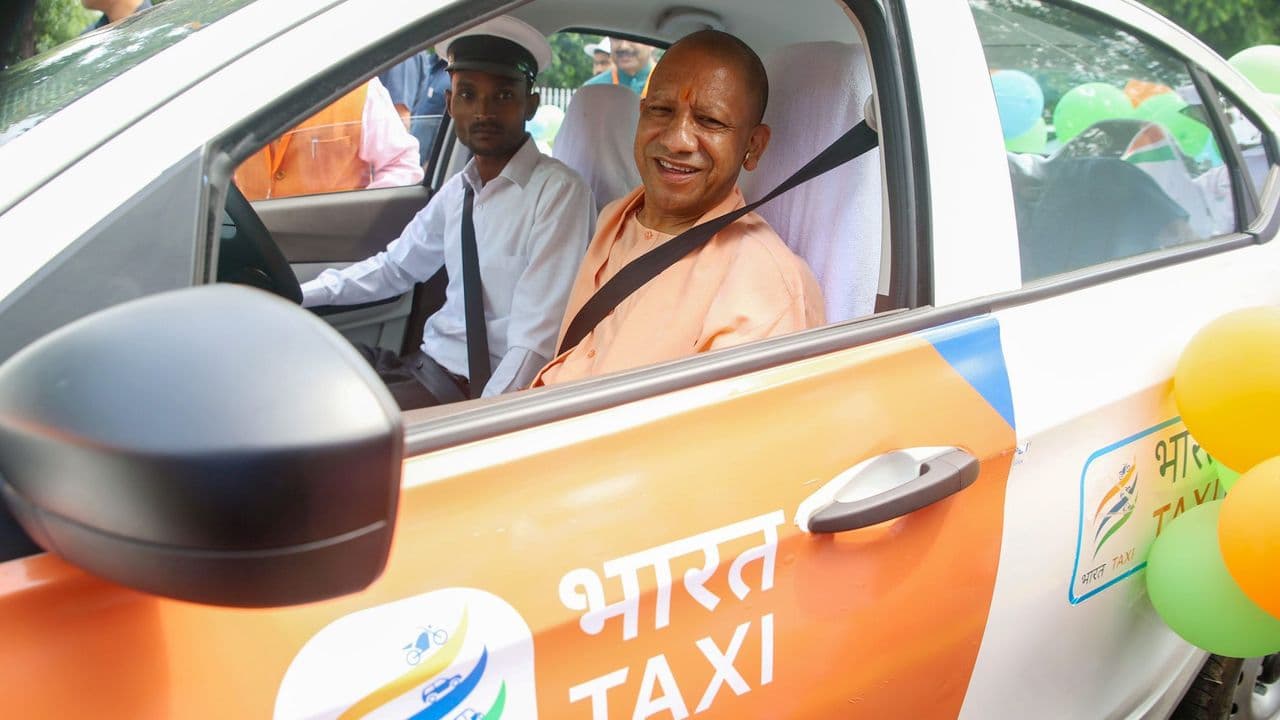
Lucknow: The Bharat Taxi service was formally launched in Uttar Pradesh on Wednesday, with operations rolled out simultaneously in Lucknow, Gorakhpur, Varanasi, Kanpur and Prayagraj.
Union Minister of State for Cooperation Murlidhar Mohol addressed the launch programme in Lucknow, which was attended by Uttar Pradesh Chief Minister Yogi Adityanath, Deputy Chief Minister Brajesh Pathak and other senior ministers and officials. More than 50,000 people from different districts of Uttar Pradesh also joined the programme online.
The launch is part of the Centre's efforts to expand the cooperative sector under Prime Minister Narendra Modi's 'Sahkar Se Samriddhi' vision and the leadership of Union Home and Cooperation Minister Amit Shah, according to the press release.
Three More Initiatives Launched
During the programme, Chief Minister Yogi Adityanath launched the Mukhyamantri Krishak Samriddhi Yojana portal.
The Urvarak Setu mobile app, developed by the Uttar Pradesh Cooperation Department, and the UPCDC mobile app of the Uttar Pradesh Cooperative Database Centre were also launched.
The Airport Authority, Lucknow Metro Rail and Lucknow Police exchanged Memoranda of Understanding with Bharat Taxi on the occasion.
'Driver is the Owner' Model
Murlidhar Mohol described Bharat Taxi as a new cooperative initiative in the mobility sector based on the principle of "Driver is the Owner."
According to the Minister, the model seeks to make drivers, referred to as Saarthis, stakeholders and owners within the cooperative structure rather than merely service providers.
The press release states that Bharat Taxi is designed to ensure that a larger share of earnings goes directly to Saarthis, while the cooperative structure provides them with ownership and participation in decision-making.
The service was launched in February 2026, and the Minister said more than 10 lakh Saarthis had joined the platform within six months. Around 20,000 rides are being completed every day, while approximately 40 lakh passengers have joined the service.
More than Rs. 100 crore has reportedly been credited to Saarthis' accounts during the last six months.
With its expansion into the five Uttar Pradesh cities, around 40,000 Saarthis have registered across Lucknow, Gorakhpur, Varanasi, Kanpur and Prayagraj and are expected to begin providing services.
160 Cooperative Initiatives in Five Years
Mohol said the Ministry of Cooperation had launched more than 160 initiatives over the past five years to strengthen cooperative institutions and make them more transparent, modern and economically capable.
He said India currently has around 8.5 lakh cooperative societies with nearly 32 crore members, with cooperatives active across around 30 sectors.
The Minister also highlighted the ongoing computerisation of around 80,000 Primary Agricultural Credit Societies (PACS) across the country at an estimated cost of Rs. 3,000 crore.
According to the release, PACS are increasingly being connected with activities beyond agricultural credit, including foodgrain storage, insurance, organic products, indigenous seeds, Common Service Centres, Pradhan Mantri Kisan Samriddhi Kendras, Jan Aushadhi Kendras and fuel distribution.
Focus on Seed-to-Market Cooperative Chain
The Centre has also established national-level multi-State cooperative societies focused on different stages of the agricultural value chain.
These include Bharatiya Beej Sahakari Samiti Limited (BBSSL) for quality seeds, National Cooperative Organics Limited (NCOL) for organic products and National Cooperative Exports Limited (NCEL) for exports.
The press release states that around 70,000 cooperative societies have already become associated with these three organisations.
Mohol also highlighted White Revolution 2.0, under which efforts are underway to increase India's milk production capacity by approximately 40 per cent.
He said the country's first cooperative university has been established to develop trained human resources, with Tribhuvan Sahkari University expected to contribute towards creating nearly 17 lakh trained personnel for the cooperative sector.
Uttar Pradesh Expands Cooperative Network
The Minister said around 42,000 cooperative societies are currently functioning in Uttar Pradesh.
He also highlighted the M-PACS membership campaign, under which more than 54 lakh new members, including approximately 17.5 lakh farmers, have been enrolled in the State.
The campaign has generated around Rs. 75 crore in contributions to the cooperative sector, according to the press release.
Around 6,300 PACS are being computerised in three phases in Uttar Pradesh, while approximately 750 agricultural and rural cooperative bank units are also undergoing computerisation.
Since April 2026, more than 1,200 new M-PACS, dairy, fisheries and other cooperative societies have reportedly been formed in the State, adding around one lakh members. Nearly 22 lakh new members have also joined existing cooperative societies.
Around 5,200 Common Service Centres are currently being operated through PACS in Uttar Pradesh. Approximately 7,000 M-PACS are functioning as Pradhan Mantri Kisan Samriddhi Kendras, while 161 M-PACS are providing services as Pradhan Mantri Bhartiya Janaushadhi Kendras.
Cooperative Banking Sector Strengthened
Mohol said 16 District Cooperative Banks in Uttar Pradesh had been revived with assistance of around Rs. 307 crore in recent years.
The Uttar Pradesh State Cooperative Bank has also become, according to the release, the first cooperative bank in the country authorised to issue and update Aadhaar cards.
The State is also working towards establishing a Cooperative College to promote education and training in the cooperative sector.
Mohol said the expansion of cooperation into emerging areas such as mobility demonstrated the widening scope of the cooperative movement.
He expressed confidence that the cooperative sector would continue to expand under the leadership of Prime Minister Narendra Modi and Uttar Pradesh Chief Minister Yogi Adityanath, and contribute towards the 'Viksit Bharat @2047' vision.