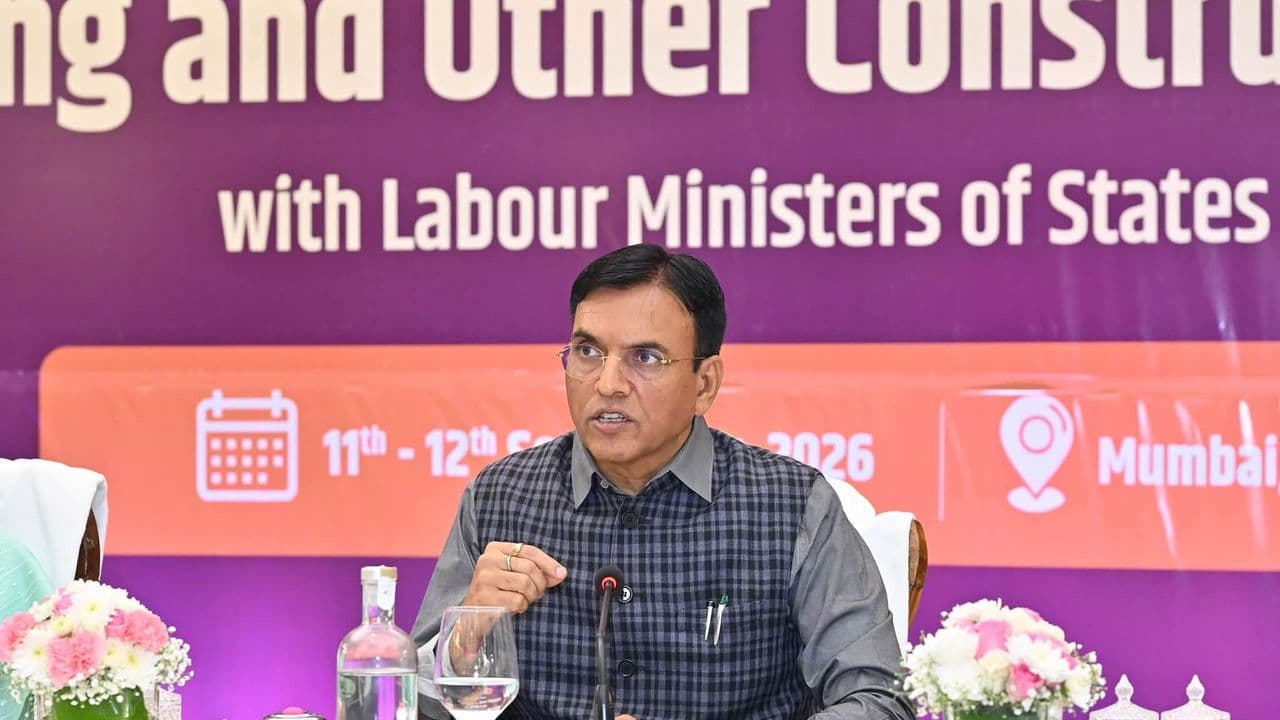
New Delhi: The Ministry of Labour and Employment has launched ‘Shram Samvad’, a 90-day nationwide awareness campaign aimed at improving understanding of the Labour Codes among workers, employers and other stakeholders.
The campaign will cover industrial clusters across 316 districts in all 36 States and Union Territories, with awareness activities focused on communicating key provisions of the Labour Codes and encouraging dialogue between industry and workers.
Union Minister for Labour and Employment and Youth Affairs and Sports Mansukh Mandaviya announced the campaign while addressing the National Conference on Industrial Relations and Labour & Awards 2026, organised by the Confederation of Indian Industry (CII) and Employers’ Federation of India (EFI) in New Delhi.
The conference was held under the theme “Reengineering Industrial Relations & Workplace Participation in the AI Age.”
Mandaviya Calls for Greater Dialogue
Emphasising the importance of continuous consultation among employers, workers and other stakeholders, Mandaviya said sharing best practices would help strengthen industrial relations and ensure that the interests of industry and workers advance together.
“Wherever there is Samvaad, there is Samadhan,” the minister said, stressing the role of dialogue in resolving workplace issues.
He called for greater cooperation between industry and labour representatives, particularly as technological developments continue to reshape workplaces and employment patterns.
AI Creating New Skill Requirements
Mandaviya said India's labour and social security systems would need to evolve alongside changing economic conditions and technological developments.
Highlighting opportunities emerging from Artificial Intelligence, automation and robotics, he stressed the importance of equipping young people with new-age skills.
The minister referred to Prime Minister Narendra Modi's Independence Day address in 2026, in which the Prime Minister announced a target of training one crore youth in AI skills over the next year.
Mandaviya said developing a workforce equipped for emerging technologies would be important for India's future employment landscape.
Social Security Coverage Expands
The minister also highlighted the expansion of social security coverage in India over the past decade.
According to figures cited by him, social security coverage increased from 19% of the population in 2015 to 68% currently, covering around 101 crore people, as recognised by the International Labour Organization (ILO).
Mandaviya said the debate should move beyond the traditional perception that policies supporting industry necessarily come at the expense of workers, or that worker-focused policies are against industry.
He said employers and workers should be viewed as partners in India's economic development.
Economic Growth and Employment
Highlighting India's 7.8% GDP growth, Mandaviya said the government's economic policies had helped sustain the country's growth trajectory.
He also cited employment data showing that between 2017 and 2023, every 1% growth in the economy was associated with 1.11% employment growth, compared with 0.008% earlier.
The minister said sustained economic growth, increased employment opportunities and a dignified workforce would be central to India's Viksit Bharat 2047 vision.
Report on Fixed-Term Employment Released
During the conference, Mandaviya also released a report titled “Employer's Guide Under New Labour Codes Framework: Fixed-Term Employment in India.”
The report focuses on the framework governing fixed-term employment under the new Labour Codes and is intended to provide employers with greater clarity on the applicable provisions.
The conference brought together industry representatives, labour stakeholders and government officials to discuss the changing nature of work and industrial relations.
Among those attending were CII Northern Region Chairman Puneet Kaura, CII National Committee on Industrial Relations & Labour Co-Chairman Harshavardhan Chitale, and ILO Deputy Director and Senior Advisor for Regional Partnership Development and Resource Mobilization Oktavianto Pasaribu.
Discussions focused on technological transformation, workplace participation, industrial relations and the challenges and opportunities emerging from India's evolving employment ecosystem.