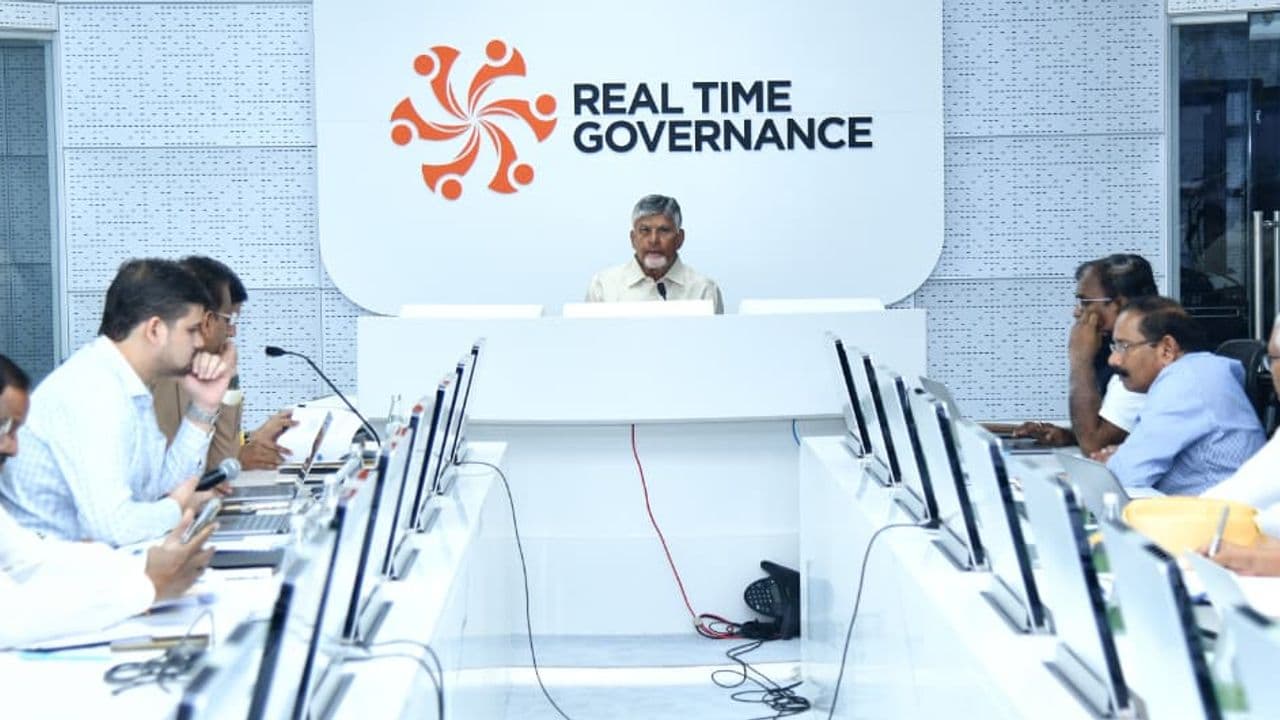
Amaravati: Andhra Pradesh Chief Minister N. Chandrababu Naidu has directed officials to make maximum use of the inflows generated by the ongoing rains and fill reservoirs, tanks and other water bodies across the state.
During a review meeting at the Real-Time Governance (RTG) Centre in Amaravati on Thursday, the Chief Minister examined rainfall, river and stream flows, reservoir inflows, groundwater recharge and the likely weather situation over the coming days.
Officials informed the Chief Minister that rainfall over the past three days, triggered by a severe depression, had resulted in an improvement in groundwater levels in several parts of the state.
Naidu directed officials to store rainwater in all available water bodies downstream of major projects. Where necessary, he asked authorities to deploy pumps and mobile lifting equipment to transfer water into tanks and other storage structures.
The Chief Minister particularly emphasised water storage in the Krishna and Godavari delta regions.
24 TMC target for Yeleru reservoir
Officials informed the meeting that around 11,000 cusecs of water was flowing towards Prakasam Barrage from the Munneru and other catchment areas.
Naidu directed officials to make arrangements to store the available water in downstream tanks and reservoirs instead of allowing the flows to go unused.
He also instructed officials to utilise Godavari inflows to fill Yeleru Reservoir with up to 24 TMC of water.
The Chief Minister further directed authorities to utilise the Polavaram Left Canal to supply water to various water bodies up to Anakapalli.
Officials said heavy rainfall had been recorded in 16 districts, with significant impacts reported in Visakhapatnam, Anakapalli, Vizianagaram, Srikakulam, Manyam, Kakinada, the Godavari districts, Eluru, Krishna and NTR districts.
Special focus on Godavari, Krishna and northern coastal basins
Naidu reviewed the intensity of rainfall and winds, rising flows in rivers and streams, inflows into reservoirs and forecasts for the coming days.
He instructed officials to maintain continuous monitoring and take preventive measures based on real-time data.
The government expects substantial inflows into several reservoirs in the Godavari basin, including Sabari, Indravati, Yeleru, Tandava, Yerrakalva, Pampa and Meghadrigadda.
According to the projections presented during the meeting, Yeleru could receive inflows of around 21,200 to 26,500 cusecs, while Tandava could receive between 6,000 and 7,500 cusecs. Meghadrigadda is expected to receive around 2,400 to 3,000 cusecs, and Pampa could receive 3,100 to 3,875 cusecs.
Officials also projected increased inflows into reservoirs in north coastal Andhra over the coming days.
The Nagavali and Vamsadhara basins are also expected to witness rising flows due to continued rainfall.
Flood warning levels monitored
Officials presented projections for several locations where water levels could approach warning thresholds.
At Gotta Barrage, the first warning level could be reached by the morning of September 25, according to the assessment presented to the Chief Minister.
At Bhadrachalam, officials projected that Warning Level-1 could be reached by the afternoon of September 26, followed by Warning Level-2 later that night.
At Dowleswaram Barrage, Warning Level-1 was projected for the morning of September 27 and Warning Level-2 by the evening.
Officials also said water levels at Kunta on the Sabari River could reach the warning stage by the morning of September 26.
The Chief Minister directed the administration to remain alert and take advance measures wherever required.
Focus on groundwater recharge and climate resilience
The Chief Minister also discussed strategies to reduce the impact of climate-related weather patterns such as El Niño.
Naidu said that while atmospheric phenomena could not be altered, steps could be taken to improve local conditions and strengthen resilience.
He called for greater emphasis on soil health, soil testing, alternative crop recommendations, biochar and natural farming practices. He directed officials to implement such measures initially on a pilot basis.
The Chief Minister also asked officials to use technology to forecast potential El Niño impacts and provide timely advisories to farmers.
Agricultural information, irrigation availability and reservoir conditions should be integrated into a common data system, he said.
AI and satellite data for water management
Naidu reviewed technology-based initiatives aimed at improving water management and groundwater monitoring.
He examined applications developed by Prithvi, a young professional based in the United States, which integrate datasets collected from different government departments with NASA satellite imagery.
The applications provide information on groundwater levels, changes over time and location-specific conditions.
Naidu said such data-driven analysis could help authorities make better decisions on future water management and groundwater conservation.
He also directed officials to demonstrate the benefits of an AI stack developed with Microsoft's support.
The Chief Minister said data-driven governance and AI-based analytical tools should be expanded across government departments.
Indian School of Agriculture, horticulture hub plans
Naidu said the foundation stone for the Indian School of Agriculture would be laid on October 2.
He added that a programme to develop Rayalaseema as a horticulture hub would also be launched on the same day.
The initiatives are intended to strengthen agricultural knowledge, technology adoption and horticulture-based economic activity in the region.
Sports calendar for entire state
During the review, the Chief Minister also discussed sports, education, electricity, sand supply and field-level administration.
He directed the Sports Authority of Andhra Pradesh (SAAP) to prepare an annual sports calendar and organise competitions not only in urban areas but also at the village level.
Naidu called for improvement of infrastructure in schools and asked officials to focus on service quality in the electricity sector.
With electricity consumption in the state reported at 287.214 million units, he also directed officials to monitor water availability required for power generation.
Officials were asked to continuously monitor the availability, prices and supply of sand across the state.
Field-level monitoring in 175 constituencies
The Chief Minister called for improved performance of field-level staff across all 175 Assembly constituencies.
He directed nodal officers to conduct constituency-wise meetings and issue clear instructions aimed at improving implementation and service delivery.
In the housing sector, Naidu suggested using Geeramji for infrastructure-related works.
He reiterated the need to expand the use of AI Living Labs applications and data analysis across government departments as part of the state's broader data-driven governance approach.
The review covered rainfall and flood management as well as agriculture, groundwater, power, education, sports, housing and technology, with the Chief Minister directing officials to use real-time data for planning and early intervention.