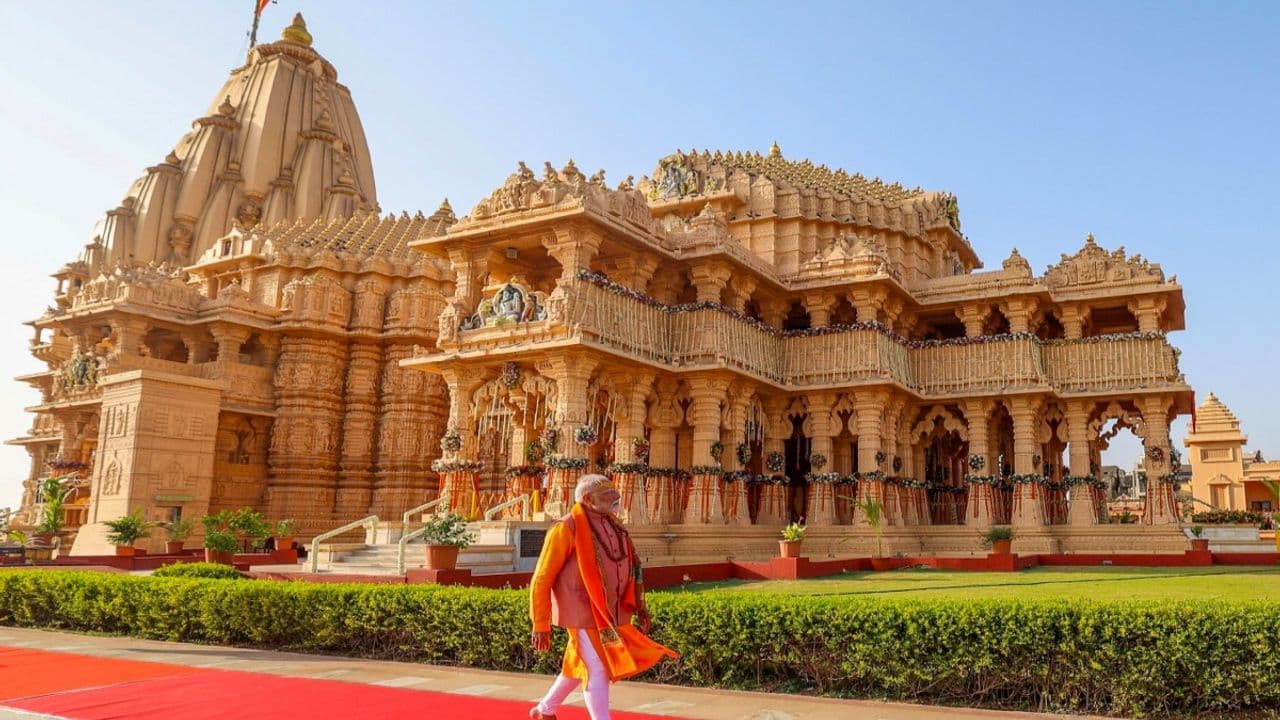
New Delhi: Prime Minister Narendra Modi highlighted India’s historical resilience, cultural heritage and continuing efforts to preserve its ancient legacy while recalling the histories of the Somnath Temple and Modhera Sun Temple during the 138th episode of his monthly radio programme Mann Ki Baat.
The Prime Minister reflected on the history of Somnath and the Somnath Swabhiman Parv, which was organised to commemorate the temple’s long history and enduring legacy. The Prime Minister had earlier described the Somnath Swabhiman Parv as a celebration of India’s strength, continuity and civilisational heritage. PM India
Somnath and the story of resilience
Recalling the history of the Somnath Temple, Modi said that Mahmud of Ghazni attacked and demolished the temple in 1026.
He contrasted the historical destruction of the temple with its continued existence as a major centre of faith and heritage.
The Prime Minister said that those who sought to destroy Somnath and erase India’s identity had disappeared from history, while the temple continues to stand on the Gujarat coast.
Modi said the history of Somnath should be viewed not merely through the episodes of destruction but also through the repeated efforts to rebuild and preserve the temple.
In his earlier address at the Somnath Swabhiman Parv, the Prime Minister similarly described Somnath’s history as one of reconstruction and renewal and said the temple continues to stand after a thousand years. PM India
Modhera Sun Temple also attacked in 1026
Turning to Modhera in Gujarat, Modi said the famous Sun Temple was also attacked in the same year as the destruction of Somnath.
He noted that the Modhera Sun Temple had been constructed in 1025 during the reign of King Bhimdev I, just a year before the attack attributed to Ghazni.
The Prime Minister said the attacks on major centres of faith during that period could have severely affected the morale of society and rulers. However, he highlighted the efforts associated with the reconstruction of the Modhera temple as an example of resilience.
Modi said the repeated rebuilding of Somnath also reflected this spirit of resilience.
Modhera’s transformation into a solar village
The Prime Minister also connected the heritage of Modhera with contemporary India’s focus on renewable energy.
He said the relationship between India and the Sun extends beyond temple architecture, describing the Sun as a symbol associated with light, energy, science and continuity.
Modhera has subsequently emerged as a prominent example of solar-energy adoption, with the village developed as a solar-powered settlement.
Modi also referred to tourism infrastructure in Modhera and the Modhera Dance Festival, which is held after Makar Sankranti and showcases Indian classical and cultural dance traditions.
Urging people to visit the historic site, he encouraged citizens to experience Modhera’s architectural and cultural heritage firsthand.
Connecting communities with India’s past
The Prime Minister also highlighted contemporary efforts by individuals to discover and document local heritage.
He cited the example of A. Selvaraju, associated with the Department of Tamil Studies at a college in Tamil Nadu’s Tiruchirappalli district.
According to Modi, Selvaraju developed an interest in ancient sculptures after a student brought the subject to his attention during a lecture. Subsequent discussions led to a field visit, during which several sculptures and ancient temples were identified at different locations.
The Prime Minister described such initiatives as an effective way of helping people develop a closer understanding of India’s historical legacy.
Call to preserve local heritage
Modi said India’s connection with its past remains active through the efforts of individuals and communities working to identify, understand and preserve historical sites.
He suggested that similar initiatives could be undertaken in different parts of the country, allowing people to explore local history directly and strengthen their understanding of India’s diverse heritage.
The episode placed Somnath and Modhera within a broader discussion on the relationship between India’s past and present, linking the preservation of historic sites with contemporary efforts in sustainability, tourism and cultural awareness.