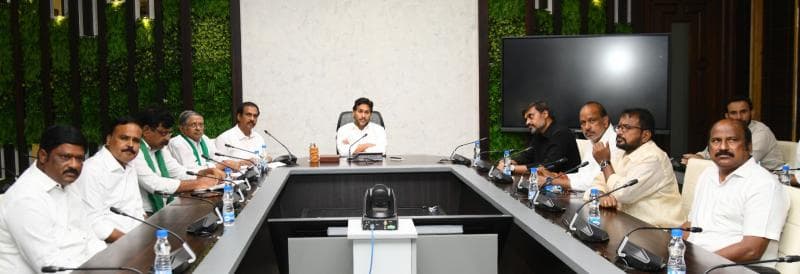
Tadepalli: YSRCP president and former Andhra Pradesh Chief Minister Y.S. Jagan Mohan Reddy has accused the Chandrababu Naidu-led government of failing to take timely measures to address the severe rainfall deficit and drought-like conditions prevailing across Andhra Pradesh.
Jagan made the allegations during a video conference with YSRCP regional coordinators and district presidents, during which he reviewed rainfall conditions, crop losses, water scarcity and the difficulties being faced by farmers across the State. The meeting had been announced by the party as a review of the drought and water scarcity situation.
Jagan cites 51% rainfall deficit
Jagan claimed that Andhra Pradesh had recorded more than 51% rainfall deficit from the beginning of the Kharif season until September 16. He said 628 of the State's 688 mandals were facing drought-like conditions, with around 332 experiencing severe drought.
Official Andhra Pradesh weather data also shows a substantial statewide rainfall deficit. As of September 17, the State had received 246.8 mm of rainfall against a normal 500.4 mm since June 1, representing a 50.7% deficit.
Jagan said the situation had affected agricultural operations significantly. According to his assessment, cultivation had covered only 56.4 lakh acres, against the normal Kharif area of around 76 lakh acres, leaving nearly 20 lakh acres unsown.
Recent agricultural data separately indicates that Kharif cultivation has fallen amid the rainfall shortage, with paddy, maize and cotton among the crops recording declines compared with the previous year.
‘Yellow Niño’ remark
Jagan criticised the State government over its response to the rainfall deficit and described the situation as a “Yellow Niño effect”, a political reference to the TDP's yellow colour.
He alleged that the government had been aware of the potential impact of El Niño but failed to take adequate preventive measures. He claimed that alternative seeds, fodder and additional employment opportunities under rural employment programmes should have been arranged in response to the rainfall shortage.
The State government, however, has publicly attributed the rainfall shortage to the El Niño effect and has announced measures to protect crops facing moisture stress. Agriculture Minister K. Atchannaidu directed officials in September to continuously assess crop conditions and provide protective irrigation wherever possible.
Concerns over irrigation water
Jagan also criticised the government's management of irrigation resources. He alleged that water from Srisailam was being used for power generation instead of being adequately supplied to Rayalaseema farmers.
He also raised concerns over Telangana's lift irrigation projects near Pulichintala and alleged that Andhra Pradesh's interests relating to the full storage capacity of the Polavaram project were being compromised.
These claims form part of Jagan's criticism of the government's handling of the drought and irrigation situation.
Demand for farmer compensation
Jagan demanded immediate declaration of drought-hit mandals and sought a package of measures for affected farmers.
Among his demands were:
- Rescheduling of farmers' loans
- Restoration of free crop insurance
- ₹15,000 per acre compensation for unsown land
- ₹25,000 per acre compensation for damaged crops
- ₹6,000 crore in input subsidy
- Payment of pending Annadata Sukhibhava assistance
- Restoration of zero-interest loans
- Fodder distribution in drought-affected areas
- Additional employment days under the rural employment programme
- Uninterrupted power supply
- Drinking water through free tankers
- 80% subsidy on tanker costs for fruit orchards
Jagan said crops including red gram, cotton, groundnut, maize and paddy, along with fruit orchards, had been affected by the rainfall shortage. He claimed farmers who had taken up cultivation suffered losses ranging from ₹15,000 to ₹30,000 per acre.
Party leaders asked to visit affected areas
Jagan directed YSRCP leaders to visit drought-affected areas, meet farmers and prepare district-specific reports on their problems.
He asked party leaders to submit their demands to the government and press for immediate relief measures. Jagan also said he would tour drought-affected regions based on the severity of the situation.
YSRCP State Coordinator Sajjala Ramakrishna Reddy, MP P.V. Midhun Reddy, MLC Lella Appi Reddy, former Minister Kurasala Kannababu, senior leader Sake Sailajanath, State General Secretary (Agriculture) M.V.S. Nagi Reddy, Agriculture Wing President Ginnuri Rama Rao and former MLA TJR Sudhakar Babu were among those who participated in the video conference.