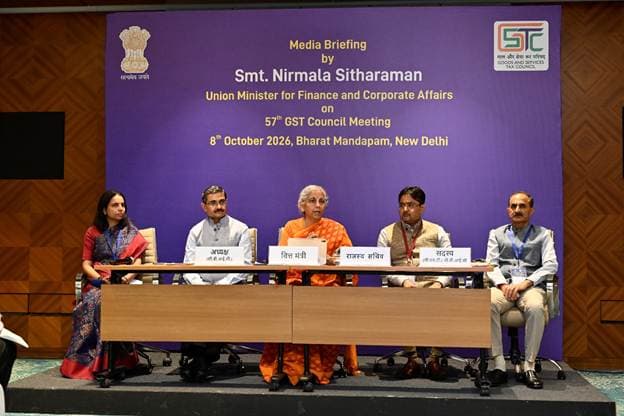
New Delhi: The 57th meeting of the GST Council, chaired by Union Finance and Corporate Affairs Minister Nirmala Sitharaman, recommended a series of reforms aimed at simplifying GST compliance, reducing taxpayer-interface with officials, speeding up refunds and strengthening ease of doing business.
The Council recommended withdrawal of arrest powers under the GST law by omitting Section 69 of the CGST Act. It also proposed raising the monetary threshold for prosecution from Rs. 1 crore to Rs. 5 crore, while rationalising provisions relating to GST offences and penalties.
The Council recommended reducing the maximum general penalty from Rs. 25,000 to Rs. 10,000. It also proposed a minimum threshold of Rs. 10,000 for issuance of GST show-cause notices and a reduced penalty of 5% in specified non-fraud cases where tax and interest are paid within the prescribed period.
Faster GST refunds
To improve cash flow and reduce compliance burdens, the Council recommended greater automation in the refund process. Under the proposed first phase, eligible refunds of excess balances in electronic cash ledgers would be sanctioned automatically, while 90% of eligible refund claims relating to zero-rated supplies and inverted duty structures would be provisionally sanctioned through a risk-based system.
The Council also proposed reducing the time for issuance of an acknowledgement or deficiency memo from 15 days to 10 days, with deemed acknowledgement where the prescribed action is not taken within the stipulated period.
Easier GST registration and cancellation
The Council recommended clearer guidelines and standardised documentation for GST registration applications, along with improvements to the GST portal to make filing more user-friendly.
It also proposed automatic acceptance of amendments to registration particulars in specified cases and a system-based mechanism for cancellation and revocation of registrations, reducing the need for direct interaction with tax officials.
Small sellers using e-commerce platforms would also benefit from a simplified registration mechanism. Eligible suppliers could register through an automated process without maintaining a physical place of business in every State or Union Territory where they sell goods, subject to prescribed conditions.
Measures to improve movement of goods
The Council recommended that vehicles carrying goods should be intercepted only on the basis of specific intelligence and authorisation by an officer not below the rank of Joint Commissioner.
It also proposed restricting interception in transit States, except in specified circumstances such as the absence of an e-way bill or documents establishing the origin or destination of goods. The measures are intended to facilitate smoother movement of goods and improve transportation efficiency.
Relief for small taxpayers
The Council approved in principle a concept for an optional Annual Return Quarterly Payment (ARQP) scheme for taxpayers with aggregate turnover of up to Rs. 5 crore who exclusively make supplies to unregistered persons.
It also recommended waiver of late fees for delayed GST returns filed by taxpayers with annual turnover up to Rs. 5 crore, subject to the specified conditions.
Boost to exports and input tax credit
The Council recommended measures to facilitate exports of services, including changes relating to the definition and place of supply of export services. It also proposed wider availability of refunds of accumulated input tax credit on specified capital goods and input services.
The recommendations also include rationalisation of certain blocked ITC provisions, including supplies relating to outdoor catering, health and life insurance, telecommunications towers and pipelines outside factory premises, among others.
Other sector-specific measures
The Council recommended several GST clarifications and exemptions covering goods and services, including nil GST on psyllium seeds, exemption for storage of seeds meant for sowing and curing of coffee, and measures relating to electric vehicle passenger transport and rental services.
It also proposed a 5% GST rate with restricted input tax credit for certain passenger transport and motor vehicle rental services using electric vehicles, along with a 5% GST rate without ITC for specified delivery services supplied through e-commerce operators.
The recommendations of the 57th GST Council meeting primarily focus on simplifying procedures, strengthening automation, reducing compliance costs and improving certainty for taxpayers and businesses. The recommendations will take effect after the necessary amendments and notifications are issued.