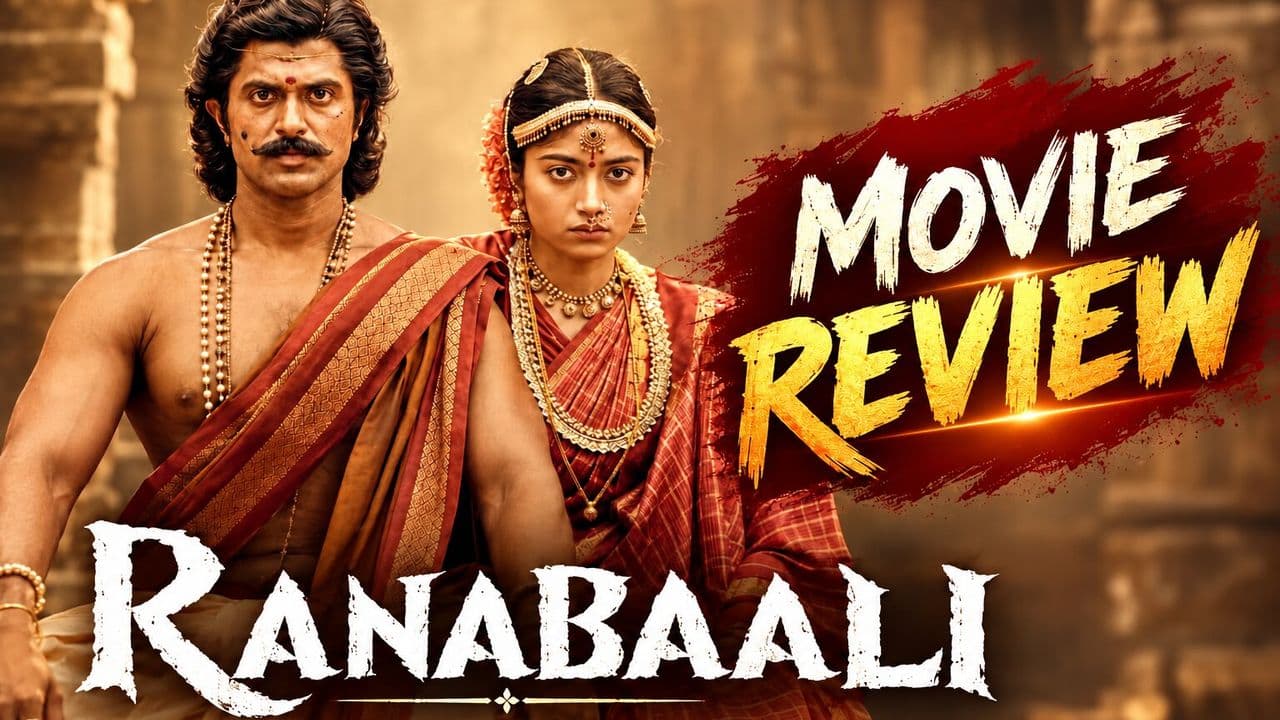
Ranabaali movie review: Vijay Deverakonda and Rashmika Mandanna star in Rahul Sankrityan's historical drama featuring colonial oppression, rebellion and striking visuals.

Ranabaali Movie Review: Vijay Deverakonda has established a distinctive screen presence through his intense performances, unconventional character choices and strong connection with audiences. With Ranabaali, the actor ventures into a period drama that combines historical themes, regional folklore, romance and rebellion. Directed by Rahul Sankrityan, the film brings together Vijay Deverakonda and Rashmika Mandanna against the backdrop of the devastating famines and colonial exploitation of the 1870s.
The film arrives with considerable expectations, particularly because of its ambitious setting and the promise of presenting a lesser-known dimension of India's colonial past. While the historical backdrop and visual presentation give the film considerable appeal, its extended narrative occasionally prevents the story from reaching its full dramatic potential.
Movie: Ranabaali
Cast: Vijay Deverakonda, Rashmika Mandanna, Arnold Oslou, Easwari Rao and others
Music: Ajay-Atul
Written and Directed by: Rahul Sankrityan
Production: Mythri Movie Makers and T-Series
Cinematography: Nirav Shah and Jishnu Bhattacharjee
Release Date: October 16, 2026
Set in the 1870s, Ranabaali unfolds during a devastating famine in the Madras Presidency. As ordinary people struggle to find food, British officials continue to enforce oppressive taxation policies and transport vast quantities of grain through ports, showing little concern for the suffering of the local population.
At the centre of this conflict is Sir Theodore Hector (Arnold Oslou), a colonial commissioner determined to move enormous quantities of grain to advance his career. His ambitions come at a terrible human cost, with thousands of families facing hunger and deprivation.

As the conflict intensifies, Ranabaali must navigate personal sacrifices, political oppression and the consequences of standing up against a powerful enemy. Jayamma (Rashmika Mandanna) becomes an important part of his emotional journey, while local traditions and the legend of Bhadramallanna Thatha add another layer to the narrative.
How Ranabaali confronts the colonial establishment and what his rebellion ultimately costs him form the crux of the film.
One of the film's strongest aspects is its choice of subject. Rather than relying entirely on familiar freedom-struggle narratives, director Rahul Sankrityan builds his story around famine, the exploitation of agricultural produce and the resistance of a fictional regional hero inspired by the spirit of Rayalaseema's historical warriors.
The screenplay attempts to combine political conflict with local folklore, cultural beliefs and personal emotions. This approach gives Ranabaali an identity of its own and provides several opportunities for compelling dramatic moments.
The protagonist's introduction establishes his rugged personality and uncompromising attitude. His confrontations with British officials provide some of the film's more engaging sequences, while certain moments involving the villagers demonstrate the screenplay's ability to balance defiance with emotional stakes.
However, the film does not maintain the same level of intensity throughout. Despite having a promising central conflict, the narrative occasionally moves at a leisurely pace, with some scenes lasting longer than necessary. Several developments also follow familiar dramatic patterns, reducing the element of surprise.
The first half builds towards a confrontation that establishes Ranabaali's challenge to the colonial authorities. The second half contains visually engaging action sequences, including a significant confrontation set in a cave. Yet the pace begins to dip as the story progresses.
The attempt to integrate spiritual beliefs and local legends into the final act offers a different dimension to the narrative. However, some of the preceding action sequences carry the weight of a climax themselves, leaving the concluding developments with a comparatively diminished impact.
Rahul Sankrityan deserves credit for attempting an ambitious period drama with a strong regional foundation. A tighter screenplay and more economical storytelling could have made the film considerably more powerful.
Vijay Deverakonda is one of the film's principal attractions. His appearance, body language and rugged screen presence suit the character of a Rayalaseema chieftain. He makes a convincing effort to bring the required intensity and defiance to Ranabaali.
His dialogue delivery in the regional dialect adds authenticity to the character, although a few lines sound somewhat strained. The actor is more effective in moments that demand physical intensity and confrontation, where his screen presence helps sustain the drama.
Rashmika Mandanna makes a natural impression as Jayamma. Her character provides an emotional counterpoint to Ranabaali's combative personality, and the chemistry between the lead pair lends warmth to the narrative. Their romantic and emotional sequences help balance the film's otherwise conflict-driven storyline.
Arnold Oslou brings a threatening presence to the antagonist's role, while Easwari Rao lends support as Ranabaali's mother. Mime Madhu, Kishore, Vinod Sagar and the other supporting actors contribute effectively to the film's broader dramatic setting.
Technically, Ranabaali is among the film's more accomplished elements. Cinematographers Nirav Shah and Jishnu Bhattacharjee recreate the period setting with considerable attention to the landscape, the famine-stricken surroundings and the atmosphere of colonial-era rural India.
The visual treatment helps establish the harshness of the times and gives the story an expansive cinematic quality. The production design also contributes to the period setting, making the world of the film feel distinct from contemporary commercial dramas.
Ajay-Atul's music complements the film's emotional and historical dimensions. Songs such as Endayya Saami and Ranabaali stand out, while the background score adds intensity to the major confrontations.
Editing, however, could have been sharper. Trimming repetitive passages and tightening the transitions between major developments would have improved the film's rhythm and strengthened its emotional impact.
Ranabaali attempts to tell a story of colonial exploitation and resistance through the journey of a fictional regional warrior. Its historical setting, Vijay Deverakonda's performance, Rashmika Mandanna's emotional presence and impressive visual design give the film several engaging moments.
However, the uneven pacing and extended sequences prevent it from delivering the sustained dramatic impact its premise promises. A more concise screenplay could have elevated the film's strongest ideas.
For audiences who enjoy period dramas, regional folklore and stories of resistance, Ranabaali offers an interesting theatrical experience, even if its execution is not consistently compelling.
Verdict: An ambitious historical drama with strong visuals and performances, held back by its lengthy screenplay.
3 days ago